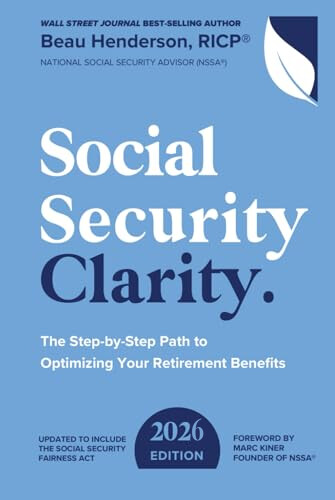
For households deciding when to claim.
Social Security Clarity
You claim once. See how timing, spousal and survivor rules apply to your household before you lock it in.
For 25 years and across more than 4,000 households, I have helped people approaching retirement build the plan to actually live the years they've worked for, not just fund them.

As Featured In
About
Helping my mother work through the financial decisions that followed revealed something I hadn't seen before: guidance, given at the right moment, can change a life. Combined with my background in psychology, that realization led me into a career I love.
Twenty-five years and more than four thousand households later, I'm still doing the same work: helping people retire toward a life that's theirs, confident, well prepared, and free to spend the money they get to use and spend.
Two free books. Pick the one that matches the question your household is facing now: when to claim Social Security, or how to handle a large IRA or 401(k).
For households deciding when to claim.
You claim once. See how timing, spousal and survivor rules apply to your household before you lock it in.

For households with large IRA or 401(k) balances.
Required distributions can push your taxes up later. Learn how to plan withdrawals and conversions before they do.
The Methodology
When you plan one piece of retirement at a time, the Social Security decision, then the taxes, then the healthcare, each one gets made without the information the others would have given you. A retirement that works is coordinated, with each piece shaped to fit the rest. That is where most households have the knowledge gap, not in which area to focus on, but in how the pieces work together.
These are not steps to take in a fixed order. Each area is shaped by the others, and a change in one can ripple into the rest.
The why behind the money.
Aligning financial decisions with your long-term goals. The plan that lasts is usually the one you can actually live with, in good markets and bad ones.
How it connects
Your priorities set the target for every other area: how much income you want, how much risk you can sit with, and what you hope to leave behind.
A dependable monthly paycheck.
Mapping reliable income to real expenses, including Social Security claiming choices and coordination between spouses.
How it connects
When you claim Social Security can change how much you may need to draw from savings in the early years, and for married couples it can affect the income a surviving spouse keeps.
Allocation built around you.
An allocation shaped by your goals, timeline and personal risk tolerance, rather than a one-size template.
How it connects
Withdrawals depend on your income plan, and which accounts you draw from can change your tax picture. Money set aside for near-term spending may be invested differently from money meant for later.
Look at the whole timeline.
Forward-looking, tax-aware choices about when and how money moves, today and over the decades ahead.
How it connects
A Roth conversion or a large IRA withdrawal can raise taxable income for that year, which may affect how Social Security benefits are taxed and, about two years later, Medicare premiums.
Plan for the cost of care.
Anticipating healthcare and long-term care costs so a single event is less likely to unravel decades of saving.
How it connects
Medicare premiums can rise with reported income, so tax decisions matter here. A long-term care need could also draw on the same savings you planned for income or for heirs.
What you pass on.
Protecting and transferring what you have built to the people and causes you care about, with intention and fewer surprises.
How it connects
Beneficiary designations often control accounts regardless of what a will says. Survivor income, the account types heirs receive and their taxes all tie back to the income and tax decisions made earlier.
The Podcast
Each episode, I break down what is happening in retirement planning: the rules nobody explains, the questions you may be afraid to ask, and conversations with the experts I learn from. It is the show I would want to hear if I were the one driving home on a Sunday afternoon.
Beyond the Book
The book teaches the system. If you want help building it for your household, that work happens at RichLife Advisors, where my team and I sit down with families one on one.
Visit RichLife Advisors